Three forces converged in the last twenty-four months. The shape of F&I is about to change. The dealers who move first will set the terms.
For thirty years, the F&I stack barely moved. Pricing engines bolted on. Compliance tools layered up. New lender portals replaced old lender portals. The shape of the work, the data shape, the rhythm of a deal: all of it stayed the same. Five-to-eight disconnected systems, paperwork shuffling, and one star manager carrying the rooftop.
Three things changed in the last twenty-four months. Together they made an F&I overhaul not just possible but urgent.
The compliance landscape just got more dangerous, not less. The FTC's Combating Auto Retail Scams (CARS) Rule was vacated by the Fifth Circuit in January 2025 and formally withdrawn from the Code of Federal Regulations in February 2026. But that didn't slow enforcement. It accelerated it, just through different channels.
In March 2026, the FTC sent warning letters to 97 dealer groups nationwide on deceptive pricing. In April 2026, the FTC and Maryland Attorney General settled with Lindsay Automotive Group for a $3.1 million civil penalty to Maryland plus full refunds to eligible consumers, who were charged more than $75 million between April 2020 and December 2025. In August 2026, the FTC and the State of Connecticut settled with Manchester City Nissan for $4 million in consumer redress, with the owners and managers named alongside the entity. The $20 million Leader Automotive Group settlement remains the largest monetary judgment the FTC has obtained against a dealer, and the case against the group's former vice president of U.S. operations remains open. The FTC's administrative action against Asbury Automotive Group (FTC Docket 9436) was pending as of September 2026, with a motion to withdraw the matter from adjudication filed August 27, 2026. California's CARS Act (SB 766), signed October 6, 2025, is operative October 1, 2026. What has changed most is who pays and who is named: in a first-instance Section 5 case the FTC's remedy is an order that binds conduct for years, the money arrives with the state co-plaintiff, and complaints now name individuals alongside the entity.
Manual disclosure tracking and paperwork-by-hand are not a defense in this environment. Audit trails reconstructed from memory and yellow-pad notes don't survive a regulator who knows the file format better than your DMS rep does. The cost of running F&I the way it ran in 2019 keeps climbing.
The reason F&I never got AI-native software before now isn't lack of interest. It's that the work is hard. Cross-lender rate comparison, menu personalization keyed to a buyer's payment target, real-time compliance checks on every disclosure: these aren't tasks you can ship with a 2018-era ML pipeline.
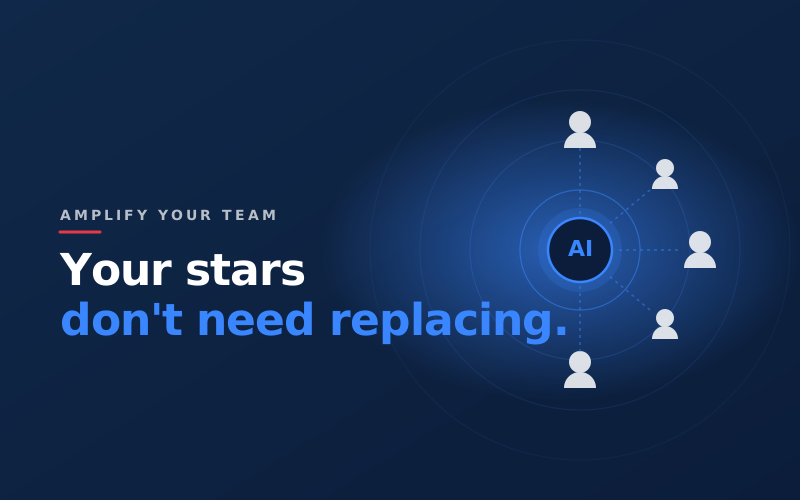
Frontier-grade language models, paired with retrieval-augmented generation against proprietary dealer data, finally match the complexity of a real F&I deal. The technology to give an F&I manager a competent co-pilot now exists. It didn't a year ago.
Customer patience with the F&I office runs out fast. NPS sits at +28 when the wait is 15 to 30 minutes and falls to -22 past an hour, a 50-point swing (CDK 2026 Friction Points Study, pages 18 and 19). Buyers walk into the box already braced. Dealer principals know it.
The other side of the desk, dealer adoption of AI tools jumped from 28% to 39% in 2025 alone. 73% of dealers using AI report measurable F&I gross improvement. Demand is real. The supply side is now finally able to meet it.
The dealers who run a 2019 F&I stack into 2027 are going to feel the squeeze from both ends. Compliance exposure is rising. Customer expectation is rising. The competitive moat of "our F&I office is great" lasts exactly as long as your star manager does.
The dealers who rebuild the F&I stack in the next twelve months won't just clear the table on cost and exposure. They'll set the customer experience benchmark for their region. The buyer who walks into a transparent, fast, well-disclosed F&I process at one rooftop is going to have a hard time accepting the old way at the next one.
The clock has just sped up. Whether that works for you or against you depends on what you do with the next twelve months.
This article draws on themes from the AiF&I white paper. Download the 13-page PDF for the deeper take, with sources, charts, and the full role-by-role breakdown.