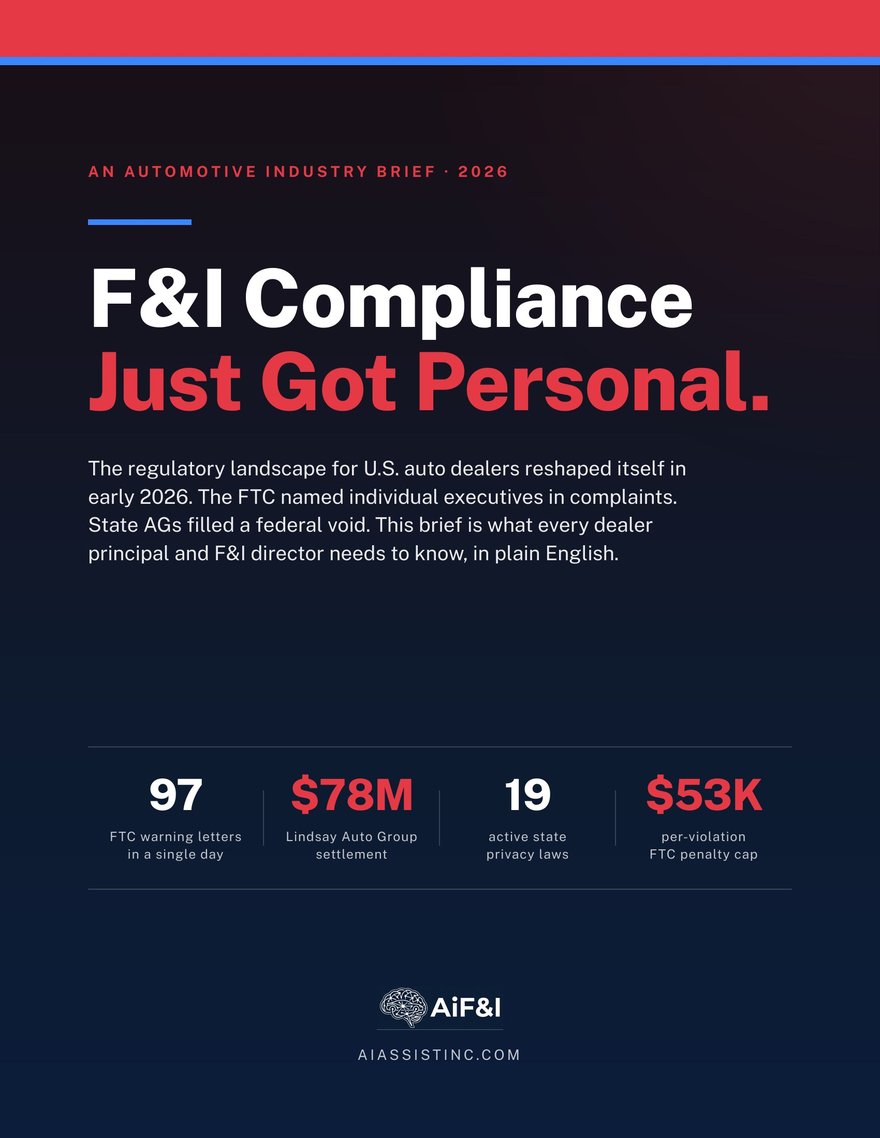
The regulatory landscape for U.S. auto dealers reshaped itself in 2026. The FTC named individual executives in complaints. Two settlements landed with a state attorney general as co-plaintiff. This brief is what every dealer principal and F&I director needs to know, in plain English.
Drop your details below and we'll email you the PDF. We'll also send the occasional update on what we're shipping at AiF&I, and you can unsubscribe any time.
Five federal actions against auto dealers, every one of them centered on advertised price and on charges the customer did not knowingly agree to. Dates, amounts, and the source for each.
The FTC and the Connecticut Attorney General settled with Chase Nissan LLC, its owners, and its managers. Regulators alleged the dealership's own data showed customers charged for certifying vehicles already advertised as certified pre-owned, and for add-ons inserted into financing agreements without their knowledge. The order requires the maximum total price to be the most prominently displayed item, and express, informed consent for every charge.
The FTC and the Maryland Attorney General settled claims of bait-and-switch pricing and unauthorized add-ons including GAP, service contracts, and certified pre-owned fees. Consumers were charged more than $75 million in disputed charges between April 2020 and December 2025; the refund total has not been determined. Per the Maryland AG, more than 88 percent of customers in a sampled period paid above the advertised price, most of them by more than $2,000.
Bureau of Consumer Protection Director Christopher Mufarrige sent identical letters to 97 auto dealership groups, roughly 203 rooftops, in a single day, citing six deceptive pricing practices. Each one maps to a prohibition from the vacated CARS Rule. The letters carried no individualized findings and are not a finding of wrongdoing. The FTC made the recipient list public on May 28, 2026. Every advertised price at a rooftop should be tested against those six.
An FTC administrative complaint issued August 16, 2024 over add-on charges and hidden fees at three Texas dealerships, with a general manager named alongside the entities. The discrimination count was withdrawn in August 2025. The hearing was continued to August 2027, and on August 27, 2026 complaint counsel moved to withdraw the matter from adjudication, a step that typically precedes a settlement. Nothing has been announced.
The FTC and the Illinois Attorney General settled with the ten-rooftop group and its parent, AutoCanada, over deceptive pricing, unauthorized add-ons, junk fees, and fake reviews. The stipulated order was entered January 2, 2025, with $19.8 million to the FTC and $200,000 to Illinois. It remains the largest monetary judgment the FTC has obtained against an auto dealer. The case against the group's former vice president of U.S. operations remains open.
The CARS Rule was vacated January 27, 2025 and formally withdrawn February 12, 2026. It never took effect. Section 5 did not go anywhere, but in a first-instance deception case the FTC's remedy is an order that binds a store's conduct for years, not a fine. The dollars arrive with the state co-plaintiff, which carries penalty and restitution authority the FTC lacks. A state attorney general was a co-plaintiff in four of the five actions above. California SB 766, signed October 6, 2025, is operative October 1, 2026.
Conduct described in complaints is alleged. Settlements were entered without admissions of liability. Stipulated final orders carry the force of law once a district judge approves and signs them. The full record, with effective dates and the nine-item plan, is in the brief above.
Twelve sections across 23 pages. What changed at the federal level, how state AGs picked up the slack, where the heat sits, and a nine-item plan for the rest of the year.
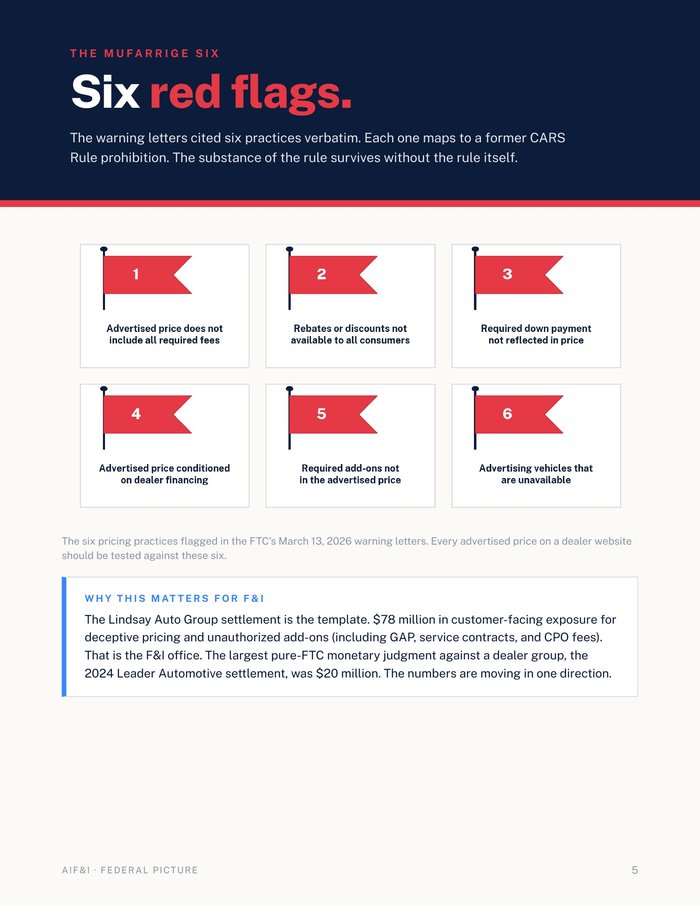
The six pricing practices cited verbatim in the FTC's March 13, 2026 warning letters to 97 dealer groups. Every advertised price should be tested against these six.
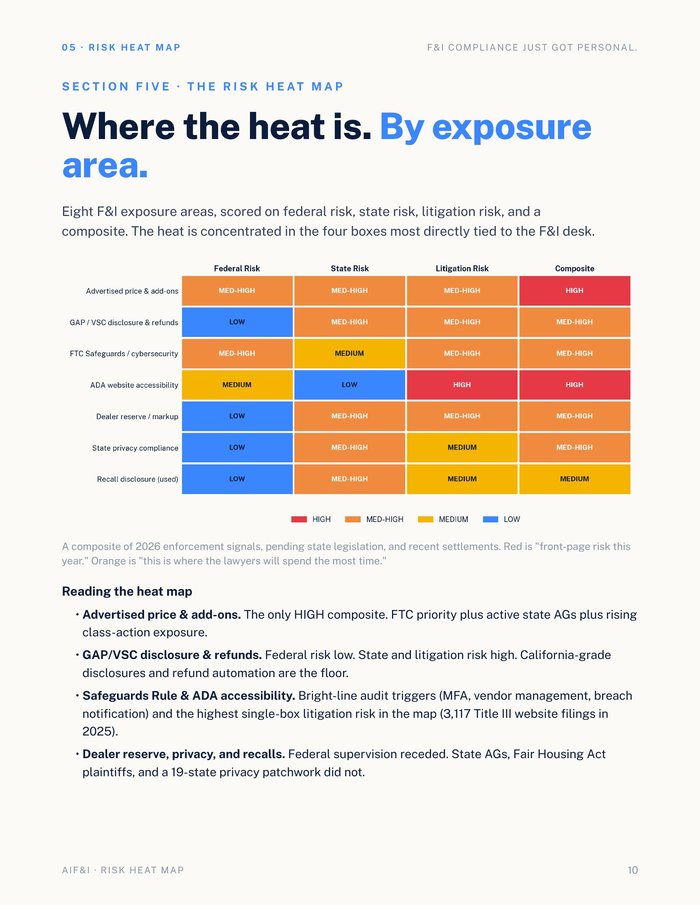
Eight F&I exposure areas scored on federal, state, and litigation risk. Seven of the eight land at high or medium-high on the composite.
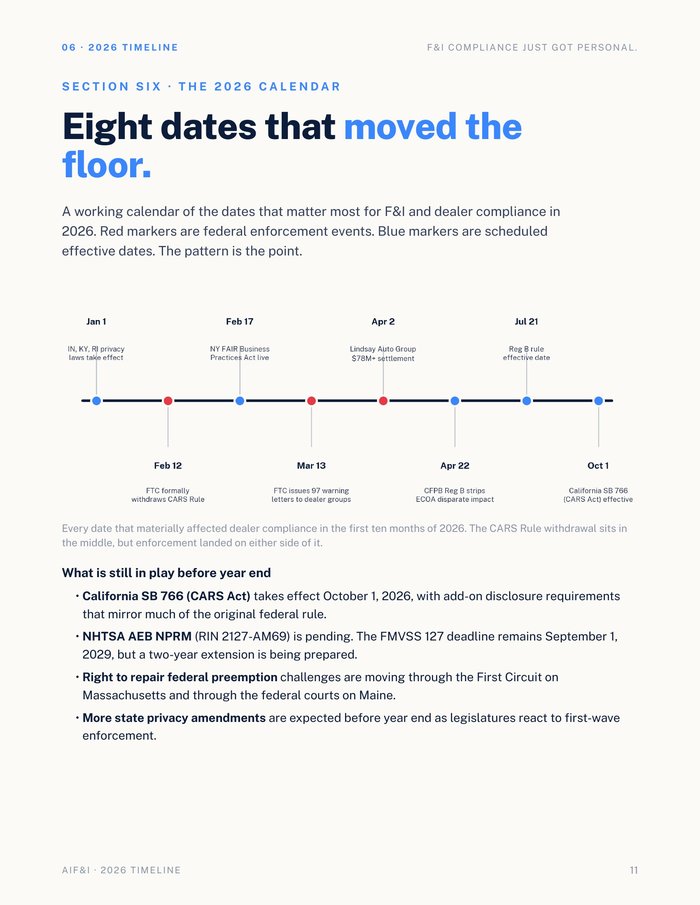
The 2026 working calendar, January through August. Enforcement events and scheduled effective dates on one line. The pattern is the point.